
- Analytics
- Technical Analysis
AUD/NZD Technical Analysis - AUD/NZD Trading: 2020-12-14
AUD/NZD Technical Analysis Summary
Above 1,065
Buy Stop
Below 1,041
Stop Loss

| Indicator | Signal |
| RSI | Buy |
| MACD | Buy |
| MA(200) | Neutral |
| Fractals | Buy |
| Parabolic SAR | Buy |
| Bollinger Bands | Buy |
AUD/NZD Chart Analysis
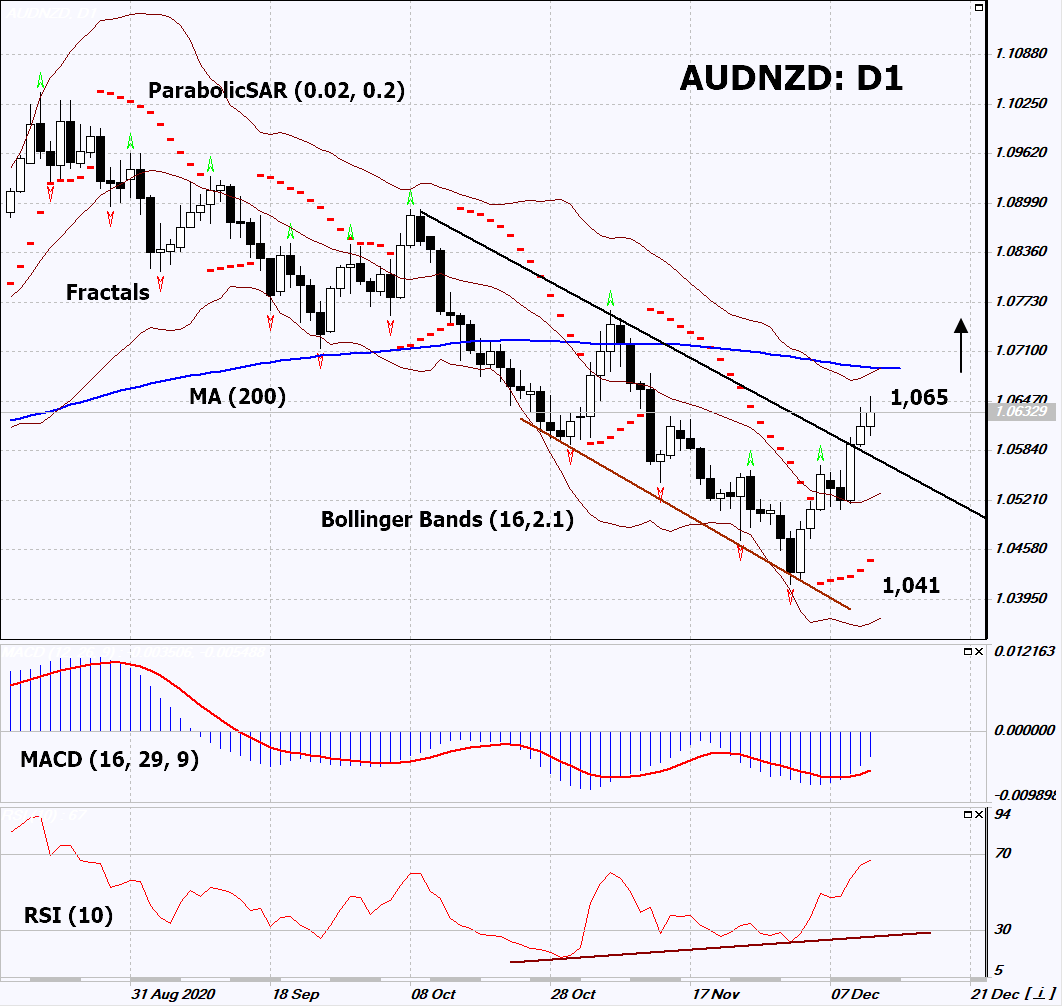
AUD/NZD Technical Analysis
On the daily timeframe, AUDNZD: D1 bounced off the minimum since April 2020 and surpassed the downtrend resistance line. A number of technical analysis indicators formed signals for further growth. We do not rule out a bullish move if AUDNZD rises above its latest high: 1.065. This level can be used as an entry point. We can place a stop loss below the Parabolic signal and the last lower fractal: 1.041. After opening a pending order, we can move the stop loss following the Bollinger and Parabolic signals to the next fractal low. Thus, we change the potential profit/loss ratio in our favor. After the transaction, the most risk-averse traders can switch to the four-hour chart and place a stop loss, moving it in the direction of the bias. If the price meets the stop loss (1.041) without activating the order (1.065), it is recommended to delete the order: some internal changes in the market have not been taken into account.
Fundamental Analysis of Forex - AUD/NZD
The Australian dollar strengthened due to marked increases in iron ore and base metals prices. Will the AUDNZD quotes continue to rise?
The upward movement means that the Australian dollar is strengthening tougher than the New Zealand dollar. The economies of the two countries are similar, but slightly more than half of Australia's exports are minerals, including ores, slags, non-ferrous and precious metals, as well as coal and LNG. The share of these goods in New Zealand's exports does not exceed 3%. Since the beginning of 2020, iron ore has risen in price by 90%. Prices for other Australian raw materials also grew significantly. This positively impacted the Australian dollar rate. The AUDNZD dynamics may be affected by the GDP of New Zealand for Q3, 2020, which will be released early in the morning on December 17. Note that Australia’s GDP fell by 3.8% annually in the 3rd quarter and grew by 3.3% quarterly.
Explore our
Trading Conditions
- Spreads from 0.0 pip
- 30,000+ Trading Instruments
- Stop Out Level - Only 10%
Ready to Trade?
Open Account Note:
This overview has an informative and tutorial character and is published for free. All the data, included in the overview, are received from public sources, recognized as more or less reliable. Moreover, there is no guarantee that the indicated information is full and precise. Overviews are not updated. The whole information in each overview, including opinion, indicators, charts and anything else, is provided only for familiarization purposes and is not financial advice or а recommendation. The whole text and its any part, as well as the charts cannot be considered as an offer to make a deal with any asset. IFC Markets and its employees under any circumstances are not liable for any action taken by someone else during or after reading the overview.